
Lisbon UNESCO Sites Guide: Belém Tower & Jerónimos Monastery
Many travelers visiting Lisbon eventually make their way to the Belém district, one of the city’s most popular areas known for its riverside views, historic monuments, and of course the famous custard tarts. What many visitors do not realize, however, is that two of Belém’s most iconic landmarks are also UNESCO World Heritage Sites.
Jerónimos Monastery and Belém Tower, both located along the Tagus River, were designated together in 1983 for their connection to Portugal’s Age of Discovery, when Portuguese sailors helped establish new maritime trade routes linking Europe, Africa, Asia, and the Americas.
Together, these two landmarks represent both the spiritual and maritime ambitions of Portugal during the height of its exploration era.
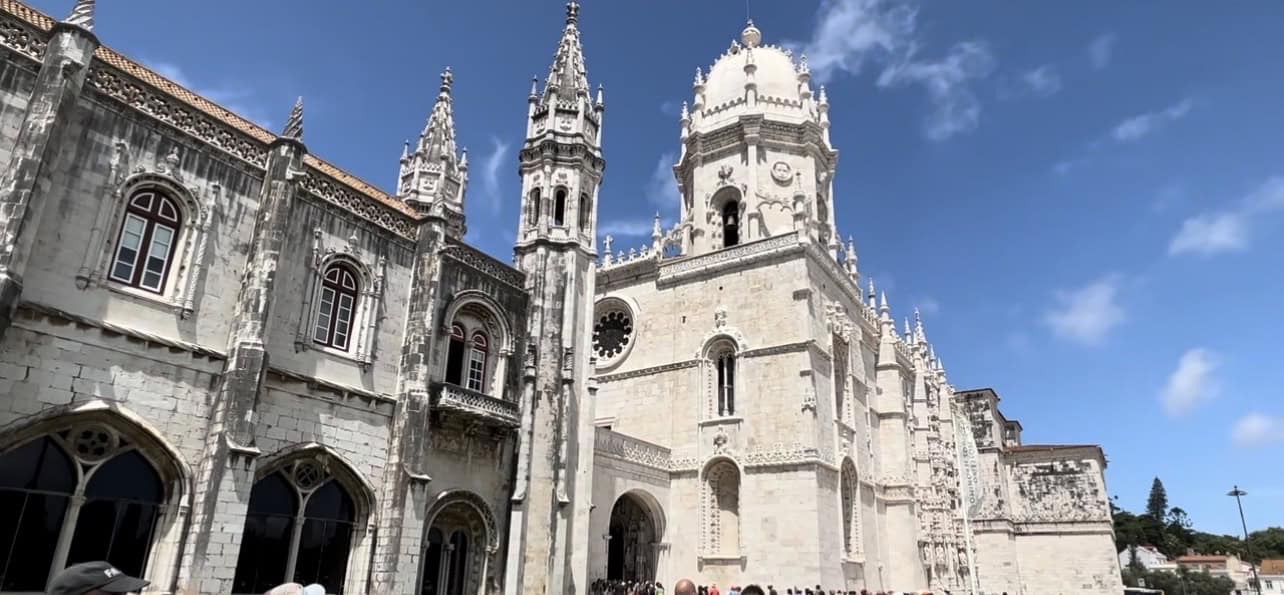
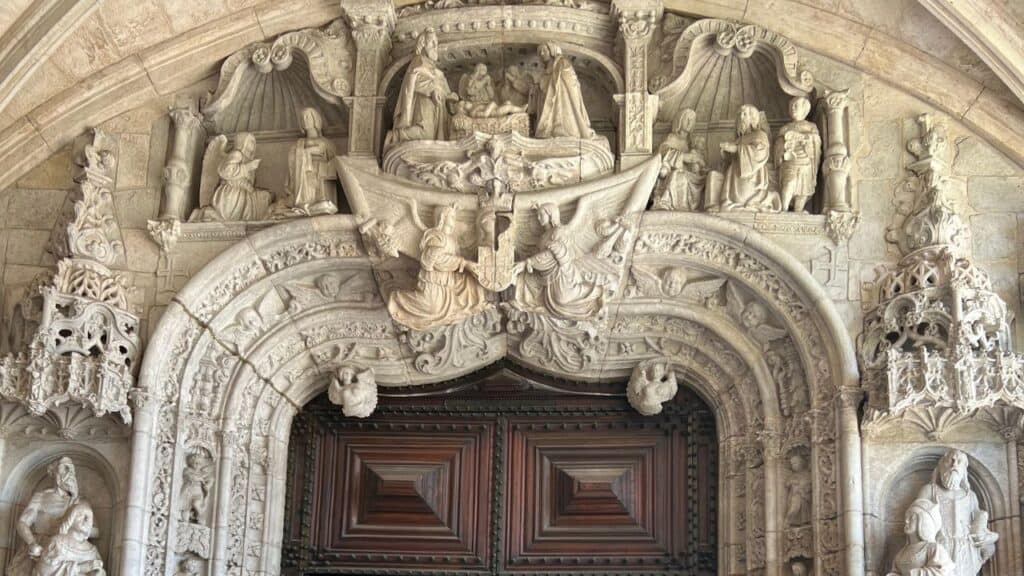
When I visited Belém, what immediately stood out was the incredibly intricate architecture. Even while waiting in line to enter Jerónimos Monastery, there was so much detail in the stone carvings that it was impossible not to keep discovering new patterns and symbols.
This traveler’s guide will help you understand why Lisbon’s UNESCO sites matter, what makes them historically significant, and how you can experience them while exploring the Belém district.
If you enjoy the deeper historical details as much as I do, keep an eye out for the Nerd Alert sections, where we dive into fascinating facts like how the global spice trade helped fund these monuments and why the intricate Manueline carvings are filled with hidden maritime symbolism.
This page contains affiliate links—if you purchase through them, I may earn a commission at no extra cost to you. Thank you for supporting my travel content and helping me bring you more UNESCO-focused content!
What Are the UNESCO World Heritage Sites in Lisbon?
Lisbon has two UNESCO World Heritage Sites: Jerónimos Monastery and Belém Tower. Both landmarks are located in the Belém district on the western part of Lisbon and along the Tagus River. They were designated UNESCO World Heritage Sites in 1983 for their connection to Portugal’s Age of Discovery.
These monuments represent the period when Portuguese explorers established new maritime trade routes linking Europe, Africa, Asia, and the Americas. Today they remain two of the most historically significant attractions in Lisbon.
Lisbon UNESCO Sites: Quick Facts
- UNESCO World Heritage Sites: 2
- Sites: Jerónimos Monastery and Belém Tower
- Location: Belém district, Lisbon, Portugal
- UNESCO designation year: 1983
- Architectural style: Manueline architecture
- Historical period: Portugal’s Age of Discovery
- Distance between the sites: About 1 mile (1.6 kilometers)
- Recommended visit time: Half a day in the Belém district
Lisbon’s two UNESCO World Heritage Sites are located in Belém, the district where many Portuguese exploration voyages began during the Age of Discovery.
Map of Lisbon’s UNESCO World Heritage Sites
Lisbon’s UNESCO World Heritage Sites are located in the historic Belém district, just a few miles west of Lisbon’s city center along the Tagus River.
The two UNESCO sites are:
- Jerónimos Monastery
- Belém Tower
These landmarks are only about 1 mile apart (1.6 kilometers), making it easy to explore the district on foot.
Because the sites are so close together, many travelers explore them as part of a single visit to the Belém district.
Planning a Visit to Lisbon’s UNESCO Sites
If you are building a Lisbon itinerary, the Belém district is one of the most rewarding areas of the city to explore.
Within a short walking distance, visitors can see two UNESCO World Heritage Sites, learn about Portugal’s Age of Discovery, and enjoy some of Lisbon’s most famous pastries.

Many travelers combine the following highlights into a single half-day visit:
- Jerónimos Monastery
- Pastéis de Belém bakery
- Monument to the Discoveries
- Belém Tower
- A walk along the Tagus River
How to Get to Lisbon’s UNESCO Sites in Belém
Belém is located about 4 miles (6 kilometers) west of Lisbon’s historic city center and is easy to reach using public transportation.
Tram 15
One of the most popular ways to reach Belém is by taking Tram 15E from central Lisbon. The tram departs from Praça da Figueira or Cais do Sodré and stops near Jerónimos Monastery.
Train from Cais do Sodré
You can also take the Cascais Line train from Cais do Sodré Station to Belém Station, which is about a 10-minute walk from Jerónimos Monastery.
Bus
Several city buses also connect central Lisbon to Belém, including routes 714, 727, and 728.
Walking or Biking
If you enjoy walking, you can follow the scenic Tagus River waterfront path from central Lisbon toward Belém. Many visitors choose to rent bikes or electric scooters and ride along the river.
Self-Guided Walking Route Through Belém
One of the easiest ways to explore Belém is with a simple walking route along the Tagus River.
Stop 1: Jerónimos Monastery
Begin at Jerónimos Monastery, admiring its intricate architecture before exploring the cloisters and historic tombs inside.
Stop 2: Pastéis de Belém
Walk to Pastéis de Belém for a famous custard tart.
Stop 3: Monument to the Discoveries
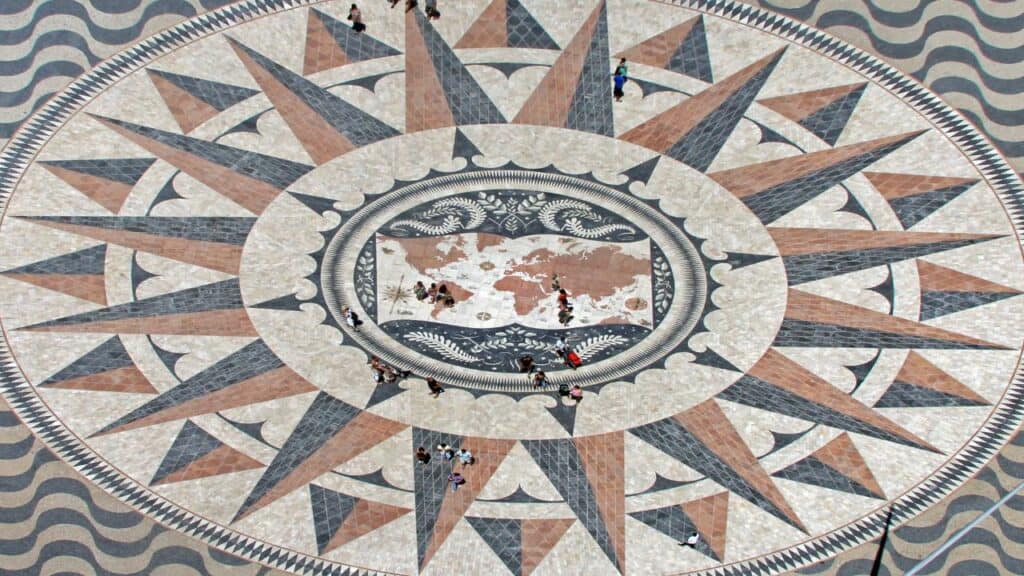
Next visit the Monument to the Discoveries, and look for the world map embedded in the plaza.
Stop 4: Belém Tower
Finish your walk at Belém Tower, where sailors once departed on voyages around the world.
Total walking distance: 1 mile (1.6 kilometers).
UNESCO Sites in Lisbon
Jerónimos Monastery
Few buildings capture the spirit of Portugal’s Age of Discovery as powerfully as Jerónimos Monastery.
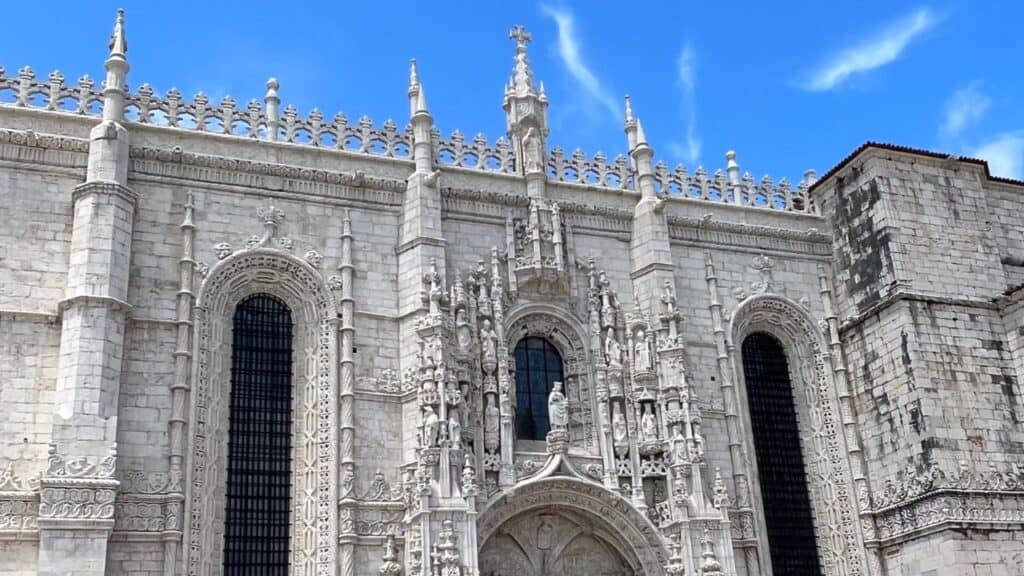
The monastery was commissioned by King Manuel I to celebrate Vasco da Gama’s successful voyage to India in 1498. Today it stands as one of the finest examples of Manueline architecture, a style named after the king himself, who ruled Portugal from 1495 to 1521 during the height of the country’s maritime expansion.
The monastery was entrusted to the Order of Saint Jerome, whose monks prayed for the king and for sailors preparing to depart on dangerous voyages.
Because of its location near the harbor, Jerónimos Monastery became closely linked with the Age of Discovery. Sailors, including Vasco da Gama and his crew, are believed to have spent the night in prayer at a chapel on this site before embarking on their historic journeys.
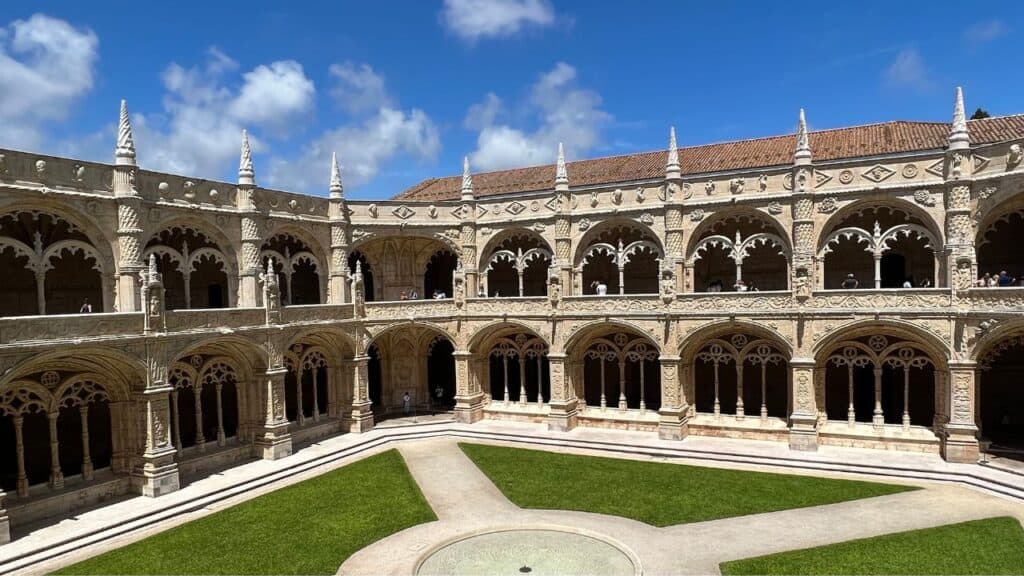
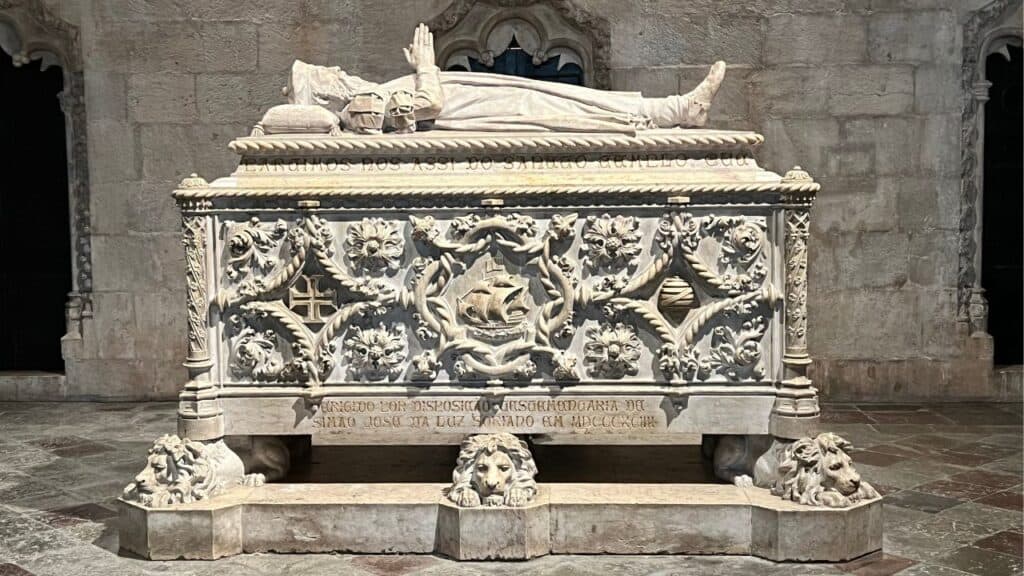
Visitors today will find the famous cloisters (pictured above) and the historic tombs of:
- Vasco da Gama (pictured below)
- Luís de Camões, the poet who praised Vasco de Gama’s expedition to India in the poem Os Lusíadas (The Lusiads)
Jerónimos Monastery Tickets
Visitors need a ticket to enter Jerónimos Monastery. Because it is one of Lisbon’s most popular attractions, lines can be long.
Some travelers choose to purchase skip-the-line tickets or guided tours.
Belém Tower
Rising from the banks of the Tagus River, Belém Tower stands as one of the most recognizable landmarks of Portugal’s Age of Discovery.
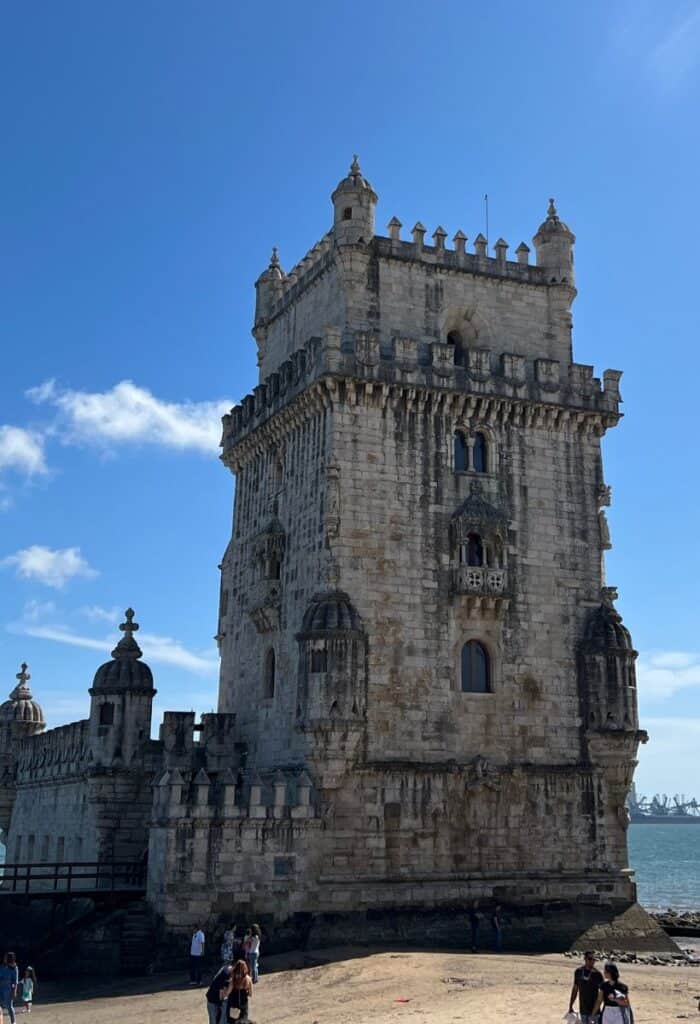
Built between 1514 and 1520, the tower defended the entrance to Lisbon’s harbor during a time when the city was becoming one of Europe’s most important ports.
Ships returning from sea routes connecting Portugal with Africa, India, and beyond would have passed directly by the tower as they entered Lisbon.
The name Belém comes from the Portuguese word for Bethlehem, reflecting the religious significance of the area and its connection to nearby Jerónimos Monastery.
For sailors departing Lisbon, the tower often represented the final view of home before venturing into unknown waters.
One unusual detail visitors sometimes miss is a small stone rhinoceros carved into the tower’s exterior, inspired by a rhinoceros brought to Portugal in 1515, one of the first seen in Europe since Roman times.
Jerónimos Monastery vs Belém Tower: Which Should You Visit?
If you are short on time, you might wonder which of Lisbon’s UNESCO sites is the better visit.
Jerónimos Monastery is best known for its stunning Manueline architecture and historical significance, including the tombs of Vasco da Gama and Luís de Camões.
Belém Tower, meanwhile, symbolizes Portugal’s maritime power and offers beautiful views of the Tagus River.
If you only have time for one:
- Choose Jerónimos Monastery for architecture and history
- Choose Belém Tower for river views and symbolism
Because the two landmarks are only 1 mile apart, most travelers visit both in a single outing.
Why These UNESCO Sites Matter
These monuments reflect the economic forces that drove exploration, particularly the global spice trade.
Spices such as:
- cinnamon
- pepper
- cloves
- nutmeg
were once worth their weight in gold.
Control of these valuable goods helped Portugal build one of the longest-lasting empires in history, lasting from 1415 to 1999.
Jerónimos Monastery itself was partially funded through tax revenue from the spice trade, linking the building directly to the global commerce that Portuguese explorers helped create.
NERD ALERT: How Portugal Mastered the Oceans
How did a small country on Europe’s edge build the longest-lasting global empire in history, spanning nearly 600 years?
They did not just explore the oceans. They learned how to control them.
Navigation Became a Science
In the early 1400s, Prince Henry the Navigator (1394–1460) led Portugal’s push into the unknown. From Sagres, on the remote southwestern tip of Portugal, he funded and organized voyages while bringing together mapmakers and astronomers to make navigation precise instead of guesswork.
From this edge of Europe, they began charting routes that would reshape the world.
The Caravel Breakthrough
This was not just a faster ship. It was smarter design: a smaller, lighter frame paired with lateen (triangular) sails that gave sailors the ability to maneuver more efficiently and take advantage of winds from multiple directions.
The Portuguese could go where others simply could not.
Control, Not Conquest
Portugal focused on strategic ports like Goa (India), Malacca (Malaysia), and Hormuz (Iran/Oman) rather than vast territories. These were not random locations; they sat at critical crossroads of global trade. If spices were moving between Asia, the Middle East, and Europe – they passed through these narrow gateways.
Control the ports, and you controlled the flow of wealth.
Owning the Sea Lanes
Through maritime permits and mastery of Atlantic wind patterns, Portugal controlled who traded, where they sailed, and how fast goods moved.
A Global Footprint That Still Exists
This empire stretched across continents and left a lasting mark:
– Africa: Angola, Mozambique, Cape Verde, Guinea-Bissau, Equatorial Guinea, and São Tomé & Príncipe
– South America: Brazil
– Asia: Timor-Leste and Macau
Today, millions of people across these regions still speak Portuguese because of this maritime empire.
A Face You Will Recognize
If you visit Lisbon’s Monument of Discoveries, look for Prince Henry the Navigator at the front. He is leading the procession, symbolizing his role in launching this era of exploration.
When You Visit the Tower of Belém
Do not just see a fortress.
This was Lisbon’s checkpoint, where ships carrying spices, wealth, and global influence passed into the city.
Manueline Architecture Explained
Manueline architecture developed in Portugal during the late 1400s and early 1500s, a period of rapid maritime expansion.
This distinctive style blends late Gothic design with symbolic elements celebrating Portugal’s exploration. Instead of simple geometric decoration, Manueline architecture often incorporates natural and nautical imagery carved directly into the stone.
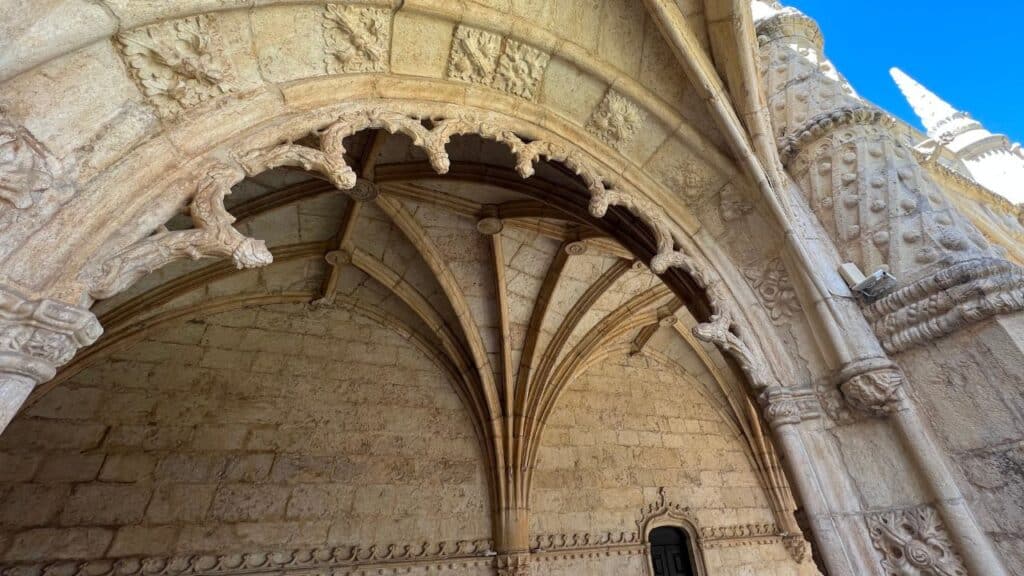
Common features include:
- Stone ropes, symbolizing Portugal’s seafaring tradition
- Nautical imagery and sea creatures
- Botanical motifs, such as carved branches and acorns as seen in the photo above
- Armillary spheres, scientific instruments used to study the stars and aid navigation
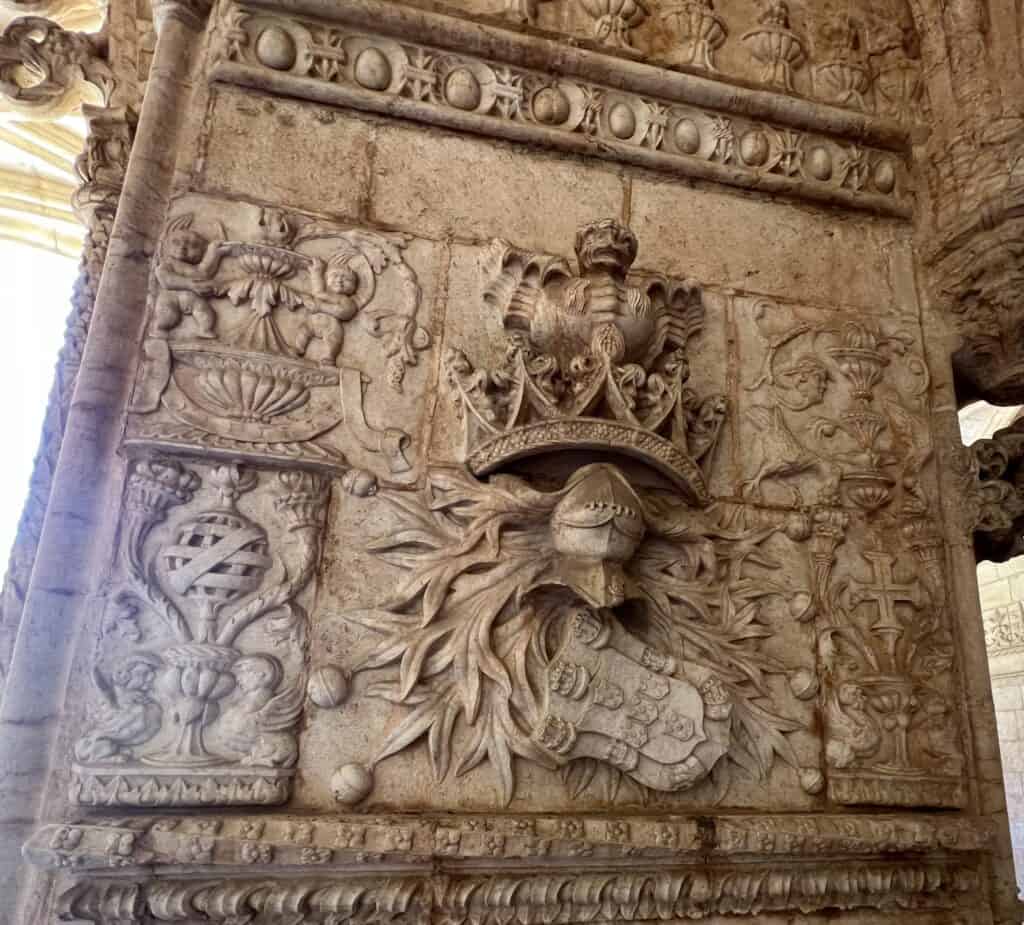
The carvings throughout Jerónimos Monastery beautifully illustrate this style. In the above photo, you can see an armillary sphere (lower left corner) carved into the stone and surrounded by richly detailed ornamental designs that celebrate Portugal’s maritime heritage.
The armillary sphere became closely associated with King Manuel I, whose reign oversaw Portugal’s global expansion. Today, it remains an important national symbol and appears prominently on the Portuguese flag.
Nerd Alert: Details Most Visitors Miss
Jerónimos Monastery Was Funded by the Spice Trade
Taxes on imported spices helped pay for the monastery’s construction.
The Tower Was Once Closer to Shore
Belém Tower originally stood closer to land before changes in the river altered the shoreline.
Sailors Prayed Here Before Voyages
Before Vasco da Gama sailed to India, he and his crew prayed at a chapel on this site.
Things to Do in Belém, Lisbon
While Jerónimos Monastery and Belém Tower are the district’s most famous landmarks, there are several other attractions nearby that help tell the story of Portugal’s Age of Discovery.
Popular things to do in Belém include:
- Visiting Jerónimos Monastery
- Walking along the Tagus River waterfront
- Seeing the statues of explorers at the Monument to the Discoveries
- Trying pastéis de nata at Pastéis de Belém
- Visiting museums such as the Museum of Art, Architecture, and Technology or the National Coach Museum
Because many of these sites are located close together, Belém is one of the easiest districts in Lisbon to explore on foot.
Exploring Belém: Lisbon’s UNESCO District
Monument to the Discoveries
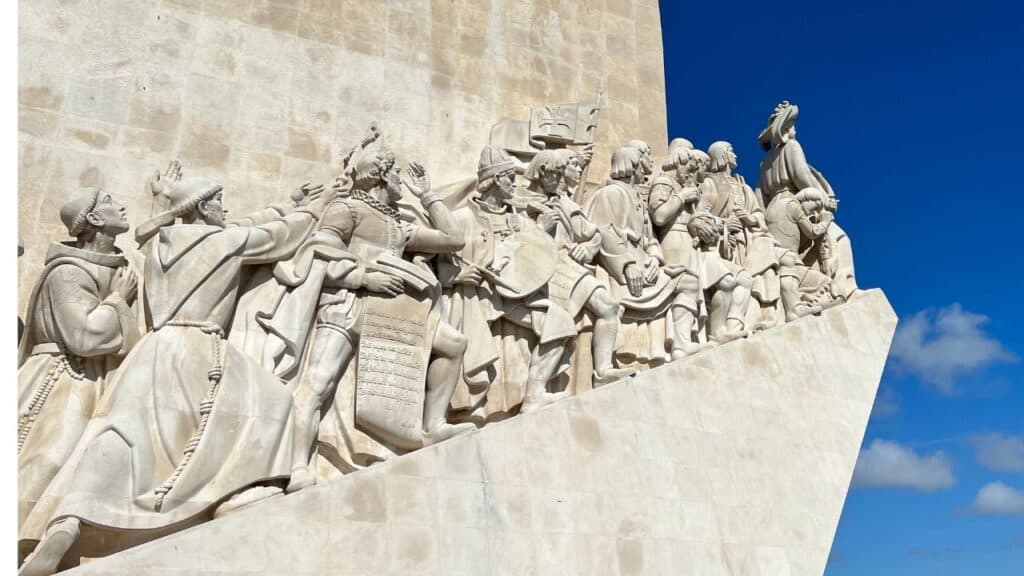
Built in 1960, the monument commemorates Prince Henry the Navigator.
It resembles the bow of a ship and features statues of explorers including:
- Prince Henry the Navigator
- Vasco da Gama
- Ferdinand Magellan
- Bartolomeu Dias
Don’t miss the large stone world map embedded in the plaza, behind the monument, showing Portuguese exploration routes.
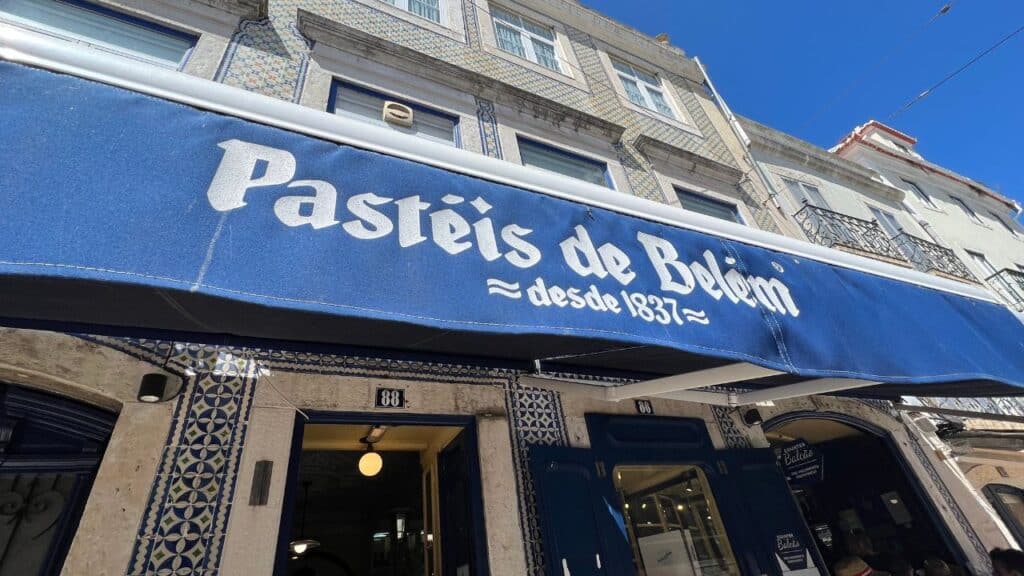
Pastéis de Belém
The famous bakery has served custard tarts since 1837.
The bakery has two entrances and two lines:
- Takeaway Line: Long queue on the right
- Dine-In Line: Often shorter and lets you see the historic kitchen
Pro Tip: Sprinkle cinnamon on top of your pastry — a delicious reminder of Portugal’s spice trade history.

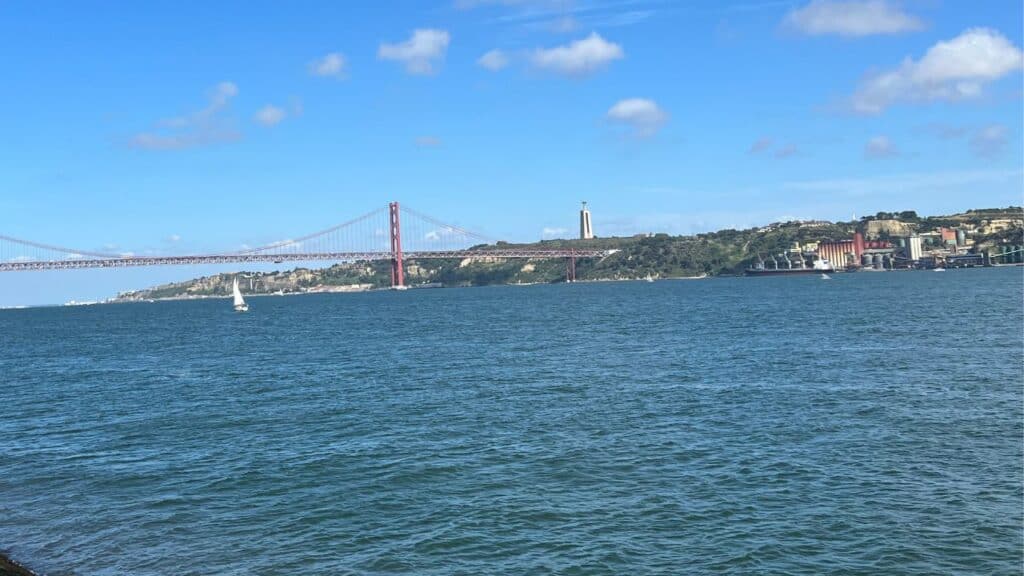
Walking Along the Tagus River
From the waterfront you can see:
- 25 de Abril Bridge, which resembles the Golden Gate Bridge
- Cristo Rei statue, inspired by Rio de Janeiro’s Christ the Redeemer
How Much Time to Plan for Lisbon’s UNESCO Sites
Jerónimos Monastery
Plan about 2 hours.
Belém Tower
Allow extra time to enjoy the riverfront and surrounding views.
Tips for Visiting Lisbon’s UNESCO Sites
- Visit Jerónimos Monastery early
- Explore Belém on foot
- Allow time to enjoy the riverfront
For itinerary planning, please look at some of my other blog posts:
Guided Tours of Lisbon’s UNESCO Sites
Some travelers prefer visiting with a guide who can explain the history of Portugal’s explorers and the Age of Discovery.
Guided Tour of Jerónimos Monastery
Guided Walking Tour of Jeronimos Monastery and Tower of Belem
FAQ About Lisbon’s UNESCO World Heritage Sites
How many UNESCO sites are in Lisbon?
Two: Jerónimos Monastery and Belém Tower.
Can you visit both in one day?
Yes. They are about 1 mile (1.6 km) apart.
Do you need tickets for Jerónimos Monastery?
Yes. Tickets are required to enter.
Is Belém Tower free?
Viewing from outside is free, but entry requires a ticket.
Final Thoughts on Lisbon’s UNESCO World Heritage Sites
Standing along the Tagus River in Belém, it is easy to feel the weight of history surrounding you.
Jerónimos Monastery and Belém Tower represent a moment when Portuguese sailors set out from Lisbon and reshaped the connections between continents.
Whether admiring the intricate Manueline architecture, tracing exploration routes on the map near the Monument to the Discoveries, or watching the river beside Belém Tower, visitors experience a powerful connection to the Age of Discovery.
If you are planning a visit to Lisbon and would like help organizing your trip, I would be happy to assist. I work with a wonderful private guide in Lisbon who offers thoughtful tours that bring the city’s history and UNESCO sites to life.
Feel free to reach out if you would like help planning your visit.