
Porto UNESCO World Heritage Sites: Your Complete Guide to Northern Portugal
This page contains affiliate links: if you purchase through them, I may earn a commission at no extra cost to you.
Thank you for supporting my travel blog and helping me bring more UNESCO-focused content your way!
I am going to be honest with you before we get started.
When I visited northern Portugal in 2023, I was not as prepared as I should have been. I had done my homework for Lisbon. I had read Cut from the Earth, understood the 1755 earthquake that devastated that city, and understood the craft behind the azulejos.
But when our trip moved north to Porto, Guimarães, and Braga, I was catching up in real time.
I stood on the staircase at Bom Jesus do Monte in Braga and did not fully understand what each landing represented.
I walked through the square in Guimarães without knowing the legend of the olive tree at its center.
I saw things that were genuinely extraordinary and did not have the historical foundation to feel their full weight.
That is exactly why I am writing this guide.
The UNESCO World Heritage Sites in Northern Portugal are not just impressive landmarks. They are layered with meaning: religious, political, architectural, and deeply human. The details I missed in 2023 are the details I am giving you here, so that your visit can be more meaningful than mine was.
I am also more prepared now than I was then. And that preparation makes all the difference.
What Are the UNESCO World Heritage Sites in Northern Portugal?
This guide covers 4 UNESCO World Heritage Sites within reach of Porto:
- Historic Center of Porto, inscribed 1996
- Alto Douro Wine Region, inscribed 2001
- Historic Center of Guimarães, inscribed 2001
- Sanctuary of Bom Jesus do Monte, Braga, inscribed 2019
Each one tells a completely different story. Together, they form one of the most historically rich regions in Europe.
Northern Portugal UNESCO Sites: Quick Facts
| Number of UNESCO sites covered | 4 |
| Base city | Porto |
| Furthest site from Porto | Guimarães / Braga (approximately 1 hour) |
| Closest site | Historic Centre of Porto (you are already there) |
| Recommended time | 4 to 5 days to experience all 4 sites meaningfully |
| Best time to visit | May or September |
| Getting around | Train for Porto, Guimarães, and Braga; car or tour for Douro Valley |
Map of Northern Portugal’s UNESCO World Heritage Sites
Planning Your Visit to Northern Portugal’s UNESCO Sites
Porto is the natural base for experiencing all 4 of these designations. The city’s historic center is your starting point. You are already inside a UNESCO site the moment you step into Ribeira. From there, Guimarães and Braga are each about 1 hour away by train, and the Douro Valley is reachable by one of the most scenic train rides in Europe.
A 4 to 5 day itinerary gives you time to experience each site without rushing. If you only have 3 days, prioritize the Historic Center of Porto and one of the two northern cities. Guimarães offers the stronger historical narrative for first-time visitors; Braga offers the more visually dramatic experience.
For a complete day-by-day plan, [click here for my full Porto itinerary]. For all day trip options from Porto including logistics and timing, [click here for my day trips from Porto guide].
How to Get Between the Sites
- Historic Center of Porto: You are already there if you are staying in Ribeira or the city center
- Douro Valley: Scenic train from São Bento station to Pinhão (approximately 2.5 hours each way); car or guided tour recommended for winery visits
- Guimarães: Train from Porto Campanhã or São Bento, approximately 1 hour
- Braga: Train from Porto Campanhã or São Bento, approximately 1 hour
The 4 UNESCO World Heritage Sites of Northern Portugal
1. Historic Center of Porto
Inscribed: 1996
Type: Cultural
Why it was inscribed: For preserving a continuous urban landscape along the Douro River that evolved continuously from around 136 BC (when Rome established Portus Cale as a trading post) through the 1800s with over 2,000 years of commercial, religious, and civic life
What Is the Historic Center of Porto?
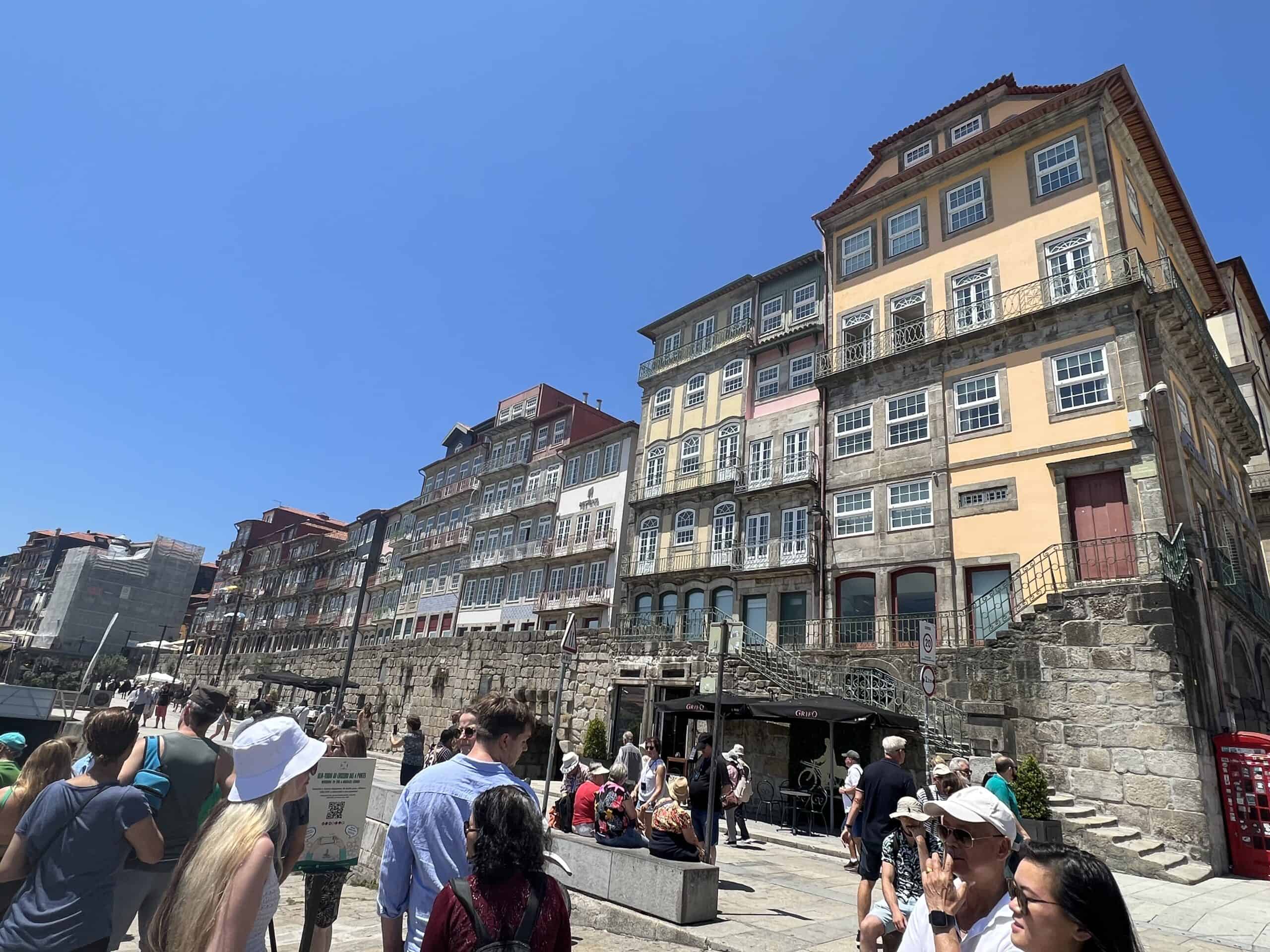
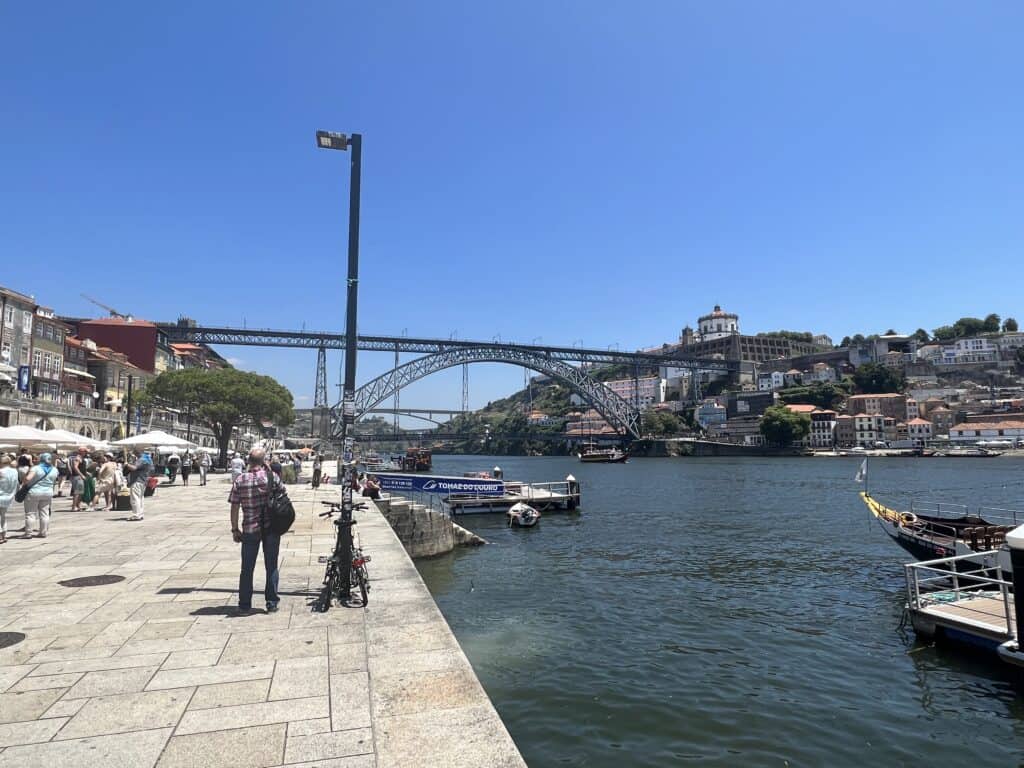
The UNESCO designation covers the Ribeira district and the broader historic center of Porto: not just one building or one monument: an entire living urban landscape. The azulejo-tiled façades, the medieval street patterns, the Romanesque cathedral, the Gothic church of São Francisco, the iron Dom Luís I Bridge, and the riverfront warehouses of Ribeira are all part of a single designation.
What UNESCO recognized here is continuity. Porto has been a functioning port city since Roman times and the bones of that city (the street grid, the hill terraces, the relationship between the upper city and the river) are still visible and still in use today.
Walking Porto’s historic center is not a museum experience. It is a lived-in city that happens to be 2,000 years old.
Nerd Alert! ✨ Porto gives Portugal its name. The city was known to the Romans as Portus Cale, a port on the Cale River (today’s Douro). When the Moors were pushed out of the region in the 700s and 800s, the territory around Portus Cale became known as Portucale, and eventually Portugal. Every time you say the word Portugal, you are referencing this city.
What to See in Porto’s Historic Center
Ribeira Square and the Waterfront This is the heart of the UNESCO designation and the most atmospheric part of Porto. The medieval street pattern is still intact, the buildings still lean at improbable angles over the Douro, and the wine cellars of Vila Nova de Gaia visible across the river have been receiving port wine from the Douro Valley for over 300 years.
São Francisco Church Built in the 1300s in Gothic style, the interior of São Francisco was transformed in the 1600s and 1700s into one of the most extravagantly gilded spaces in Portugal. The contrast between the austere Gothic exterior and the baroque gold interior is one of the great architectural surprises in the country.
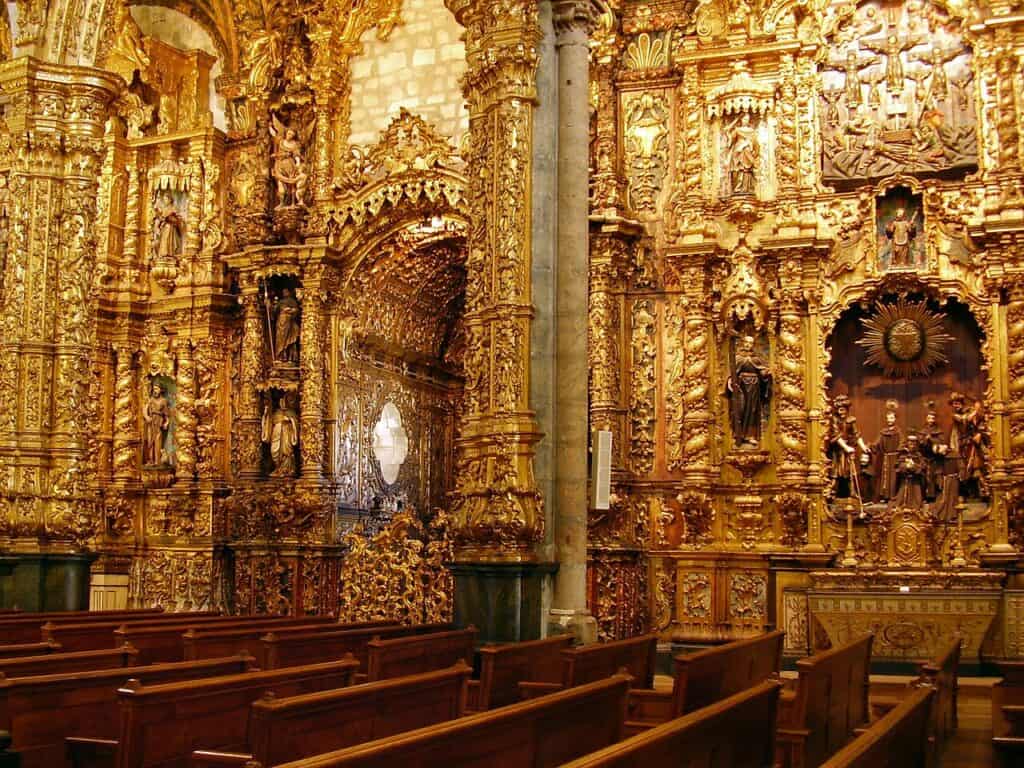
Nerd Alert! ✨ The interior of São Francisco Church is estimated to contain approximately 882 pounds (400 kilograms) of gold leaf applied during the gilding of the 1600s and 1700s. This was not decorative excess for its own sake: it was a deliberate statement of the wealth flowing through Porto from the port wine trade and Brazil. The church is essentially a monument to commerce dressed as devotion.
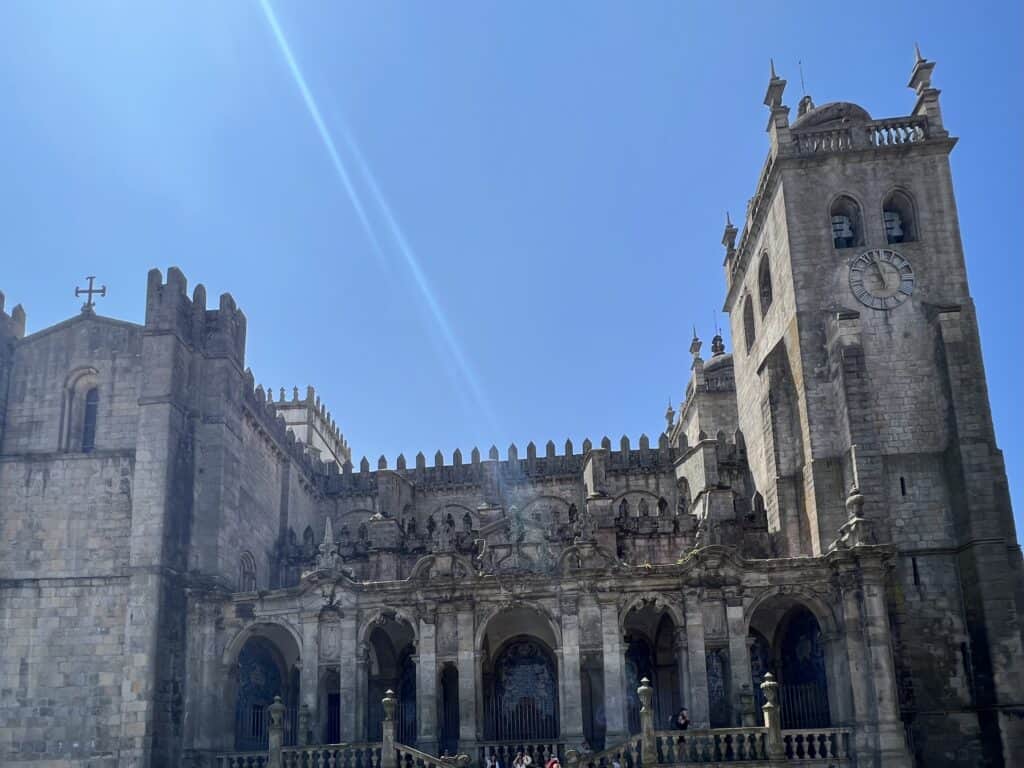
Porto Cathedral (Sé do Porto) The cathedral sits at the highest point of the historic center and has been under construction in some form since the 1100s. The Romanesque nave is the oldest surviving part. The Gothic cloister, added in the 1300s, is covered in azulejo panels added in the 1700s. Three different eras layered into a single space.
Dom Luís I Bridge Designed by a student of Gustave Eiffel and completed in 1886, the double-deck iron bridge connects Porto to Vila Nova de Gaia. The upper deck carries the metro and pedestrians at 197 feet (60 meters) above the Douro. Walking across it gives you the best view of both cities and the river between them.
Monastery of Serra do Pilar Sitting directly across the Douro in Vila Nova de Gaia, the Monastery of Serra do Pilar is part of the same UNESCO designation as Porto’s historic center. Built in the 1500s and 1600s, it is one of only 2 circular cloisters in Portugal and sits at the highest point of Gaia: the spot from which the best panoramic view of Porto’s UNESCO riverfront is photographed. The monastery itself is often overlooked by visitors who cross the Dom Luís I Bridge and head straight to the port wine cellars. Do not make that mistake.
Livraria Lello One of the most beautiful bookstore interiors in the world, with a sweeping neo-Gothic staircase and stained glass ceiling. Timed entry tickets are required and sell out. Book in advance at [livrarialello.pt].
Planning Your Visit to Porto’s Historic Center
Getting there: If you are staying in Porto, you are already there.
How long do you need: Allow at least 2 full days to experience the historic center properly. One day is not enough.
Book in advance: Livraria Lello requires timed entry tickets. Book at [livrarialello.pt], especially in summer.
Best time to visit: Early morning in Ribeira before the day-trippers arrive. The light on the river at 8:00 AM is something else entirely.
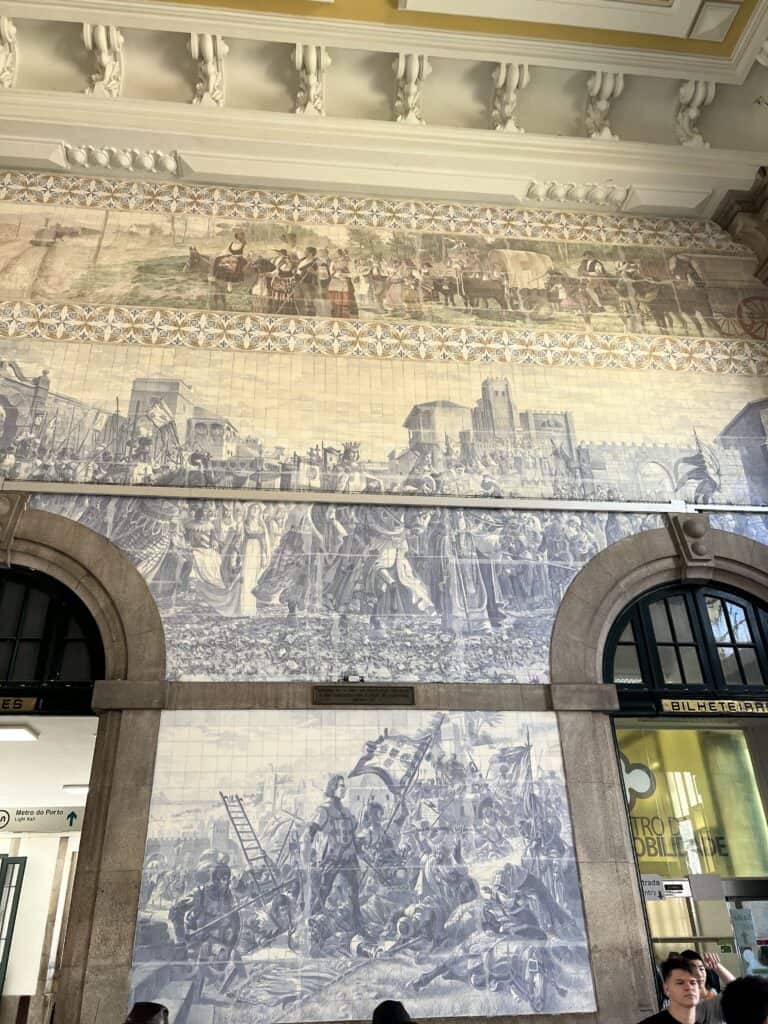
My tip: São Bento Train Station is inside the UNESCO zone and is one of the most overlooked stops in Porto. The azulejo panels covering the interior walls depict major moments in Portuguese history in extraordinary detail. I had to be pulled away. Give yourself more time than you think you need.
2. Alto Douro Wine Region
Inscribed: 2001
Type: Cultural landscape
Why it was inscribed: For preserving an agricultural and wine-growing landscape shaped by human hands over 2,000 years: the oldest officially regulated wine region in the world and a living example of the relationship between culture, economy, and geography
What Is the Alto Douro Wine Region?
In 1756, the Marquis of Pombal (the same man who rebuilt Lisbon after the Great Earthquake) drew official boundaries around the Douro River wine region, legally defining which grapes could be grown there, how they had to be cultivated, and which wines could carry the name “port”.
It was essentially a quality control system with the force of law behind it. This made the Douro the world’s first officially demarcated wine region, a designation that still shapes what is grown here, how it is grown, and who can call their wine port.
UNESCO inscribed the Alto Douro not for a single monument but for the landscape itself: the terraced vineyards cut by hand into impossibly steep slate hillsides over 2,000 years, the quintas (wine estates) that dot the valley, the river that carried the wine to Porto, and the human story behind all of it.
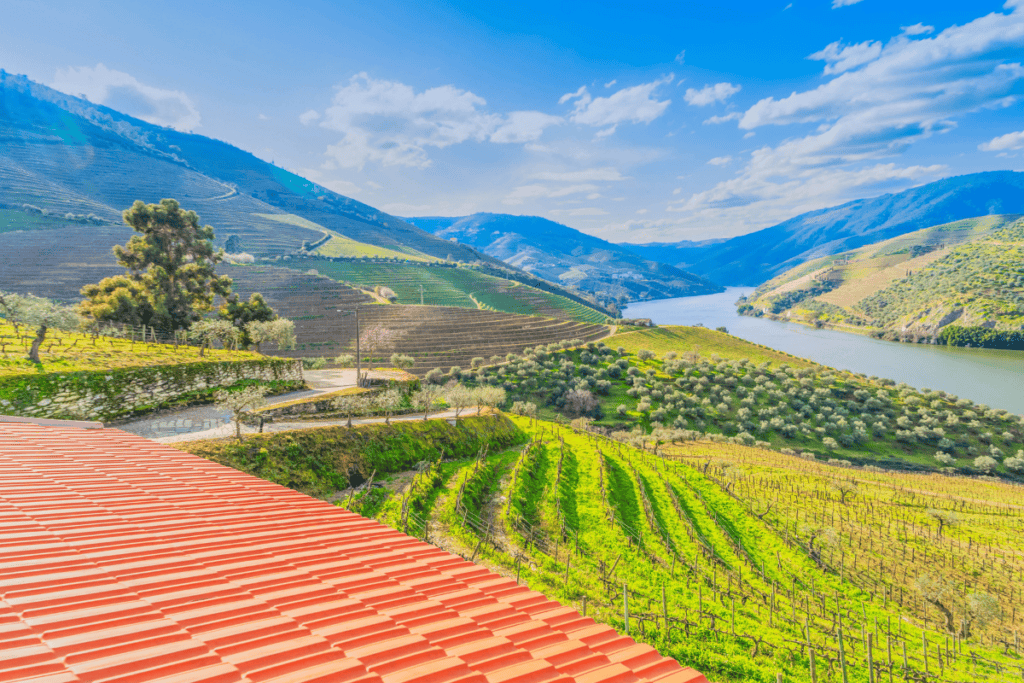
This is one of the rare UNESCO designations where the thing being preserved is still actively functioning. People still grow grapes here. They still make port wine. The landscape is still being shaped.
Nerd Alert! ✨ The terraces of the Douro Valley were not built with machinery. Every terrace was cut by hand into schist bedrock, often by workers who carved individual steps into the living rock face before building retaining walls. The schist (a dark, fractured slate-like rock) actually benefits the vines: it absorbs heat during the day and releases it at night, and its fissured structure allows vine roots to reach deep into the rock for water. The landscape that looks wild and dramatic was entirely engineered by human labor over hundreds of years.
What to See in the Douro Valley
Pinhão The town of Pinhão is the heart of the Douro Valley for visitors. The train station alone is worth the trip: its platform is covered in azulejo panels depicting the history of the wine harvest. From Pinhão, you can visit quintas for tastings, take a river cruise, or simply sit on a terrace café and look out at the terraced hillsides.
A Quinta Visit Visiting a working wine estate is the best way to understand what the UNESCO designation actually means. Most quintas offer tours and tastings that explain the relationship between the schist soil, the Atlantic climate, the Douro River, and the wine in your glass.
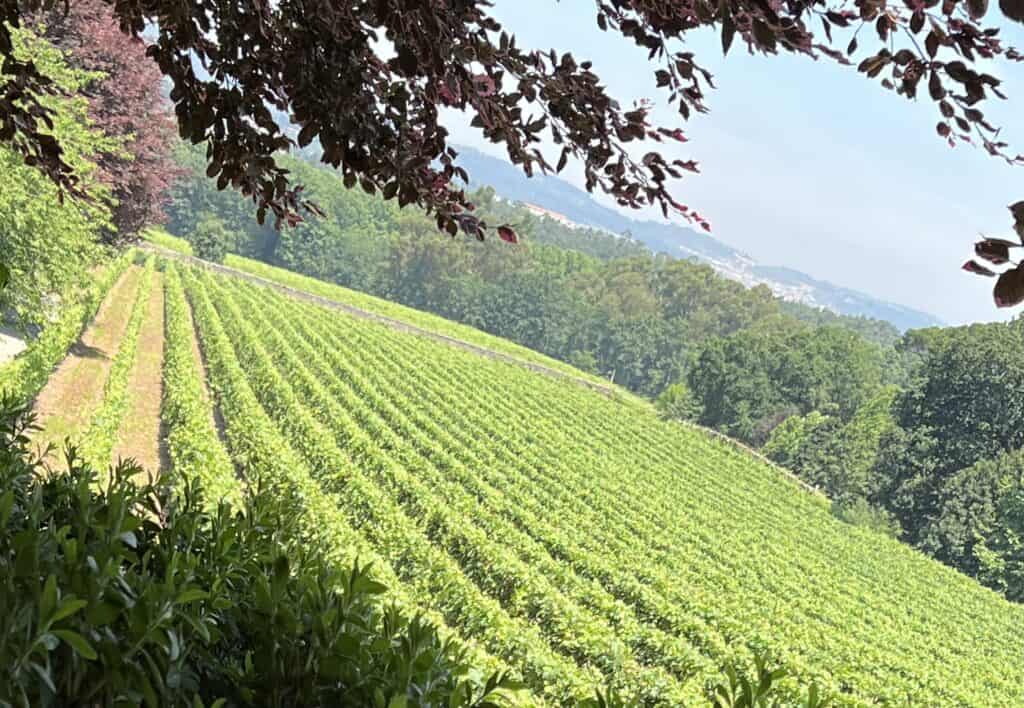
We visited Quinta de Aveleda near Porto: a half-day with a vineyard tour, garden walk, and lunch that gave me a completely different understanding of Vinho Verde country.
The Douro Train Line The scenic train from Porto’s São Bento station to Pinhão is one of the great train journeys in Europe. Sit on the right side heading east for the river views. The journey takes approximately 2.5 hours and passes through the heart of the UNESCO landscape. Buy your return ticket before you board in summer.
Planning Your Visit to the Douro Valley
Getting there:
- By train: São Bento to Pinhão, approximately 2.5 hours. Sit on the right side heading east.
- By car: About 1.5 hours / 78 miles (125 km) via A4
- By tour: Full-day tours from Porto combining wine tastings and a river cruise are available. [Search Douro Valley day tours here.]
How long do you need: Full day minimum. An overnight in the valley is worth it if your schedule allows. The evening light on the terraces and the morning mist rising off the river are two different experiences entirely.
My tip: Book your return train before you leave Porto in summer. The Douro train fills up and you do not want to be stranded in Pinhão.
3. Historic Center of Guimarães
Inscribed: 2001
Type: Cultural
Why it was inscribed: For preserving the medieval city where Portugal’s national identity first took shape: the birthplace of the nation’s first king and a remarkably intact example of medieval urban planning that influenced Portuguese town-building across four continents
What Is the Historic Center of Guimarães?
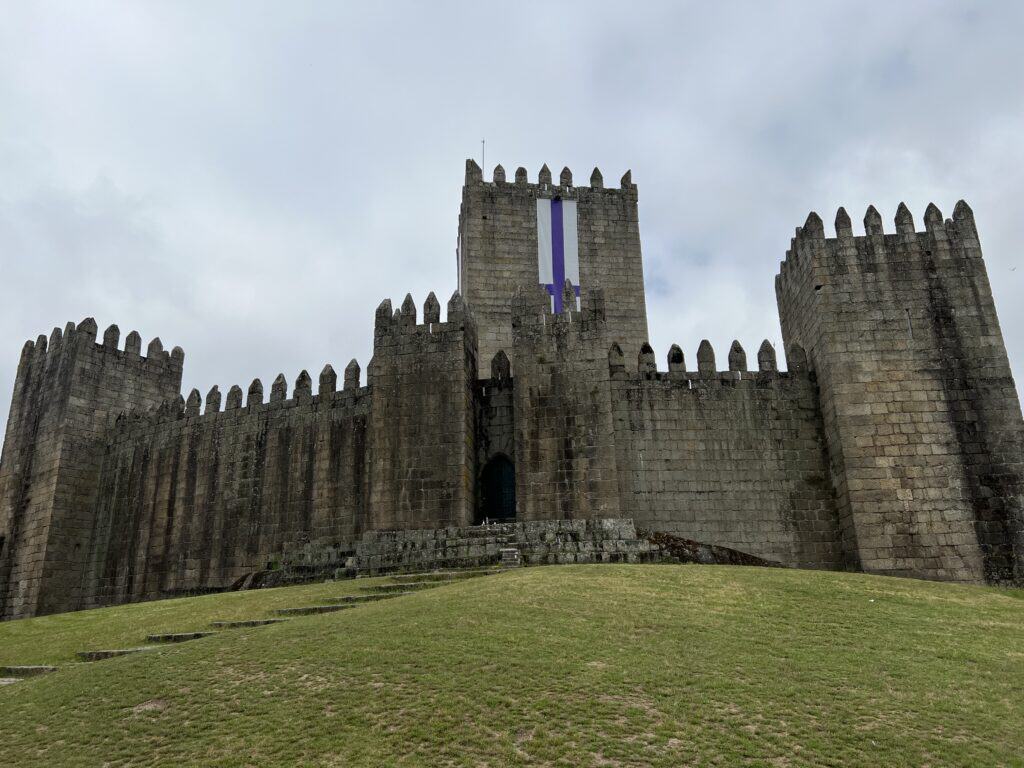
Guimarães is where Portugal began. Afonso Henriques, the nation’s first king, was likely born in Guimarães Castle around 1100. After winning a series of military victories, including the pivotal Battle of Ourique in 1139 after which he declared himself King of Portugal, he made Guimarães the first capital of the new kingdom.
The medieval city that grew around the castle in the 1100s and 1200s is still largely intact. UNESCO recognized Guimarães not just for its age but for its remarkable state of preservation and for its role as a model: the urban layout of Guimarães influenced how Portuguese towns were built across Brazil, Africa, and Asia during the Age of Discovery.
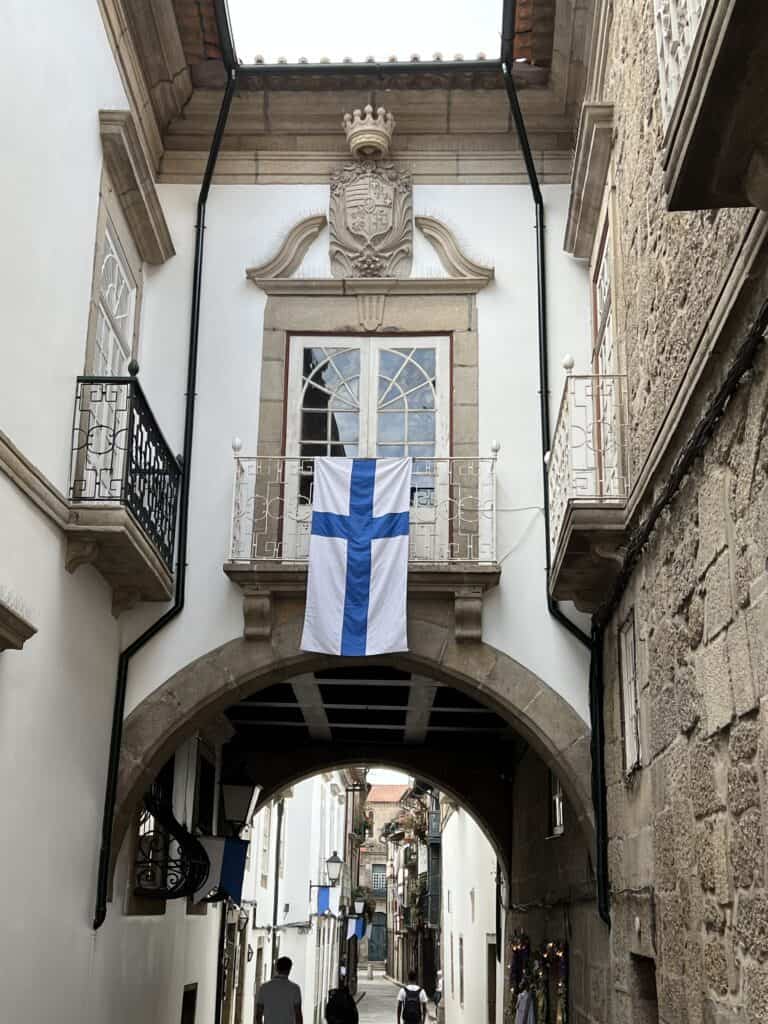
Every city Portugal built across four continents carries a piece of Guimarães in its bones.
Nerd Alert! ✨ The legend of the olive tree at the center of Oliveira Square is one of the founding stories of Guimarães. According to tradition, a local nobleman named Wamba was plowing his fields when he was told he had been elected king of the Visigoths. He drove his staff into the ground and said he would only accept the crown when the dead wood took root and grew leaves. It immediately sprouted an olive tree.
The Church of Nossa Senhora da Oliveira (Our Lady of the Olive Tree) was built on that spot, but the history layered into this square goes further than the legend.
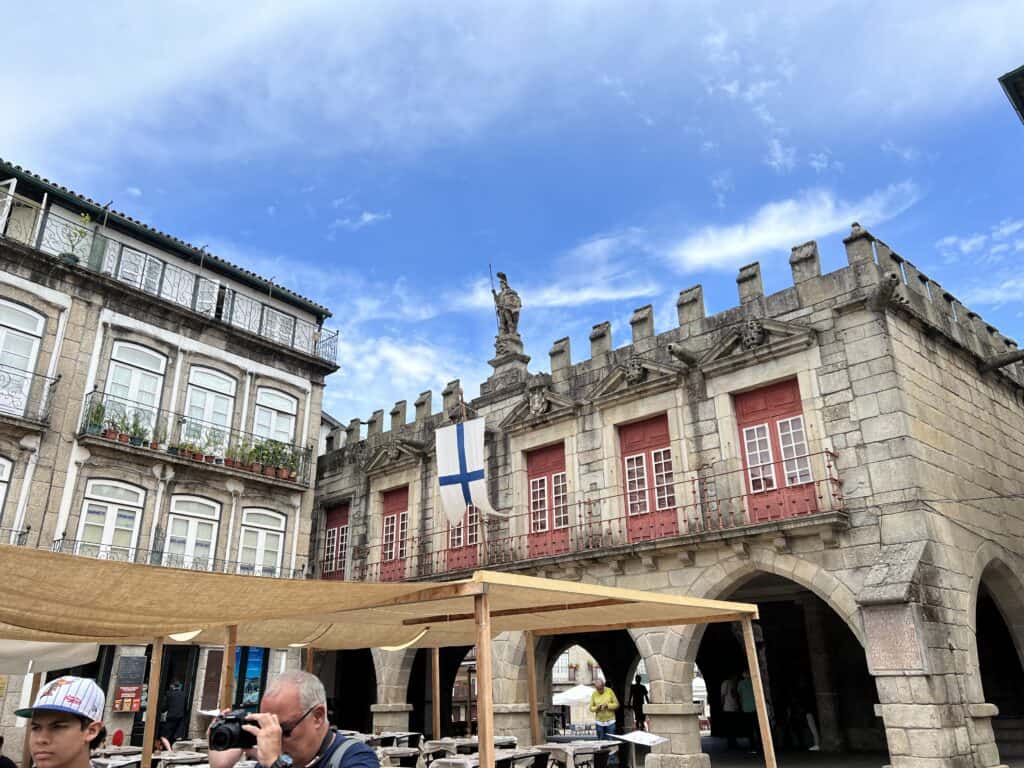
The Gothic shrine standing in the center of the square was built in 1340 to commemorate the Battle of Salado, where Portuguese and Castilian forces joined together to defeat a Moorish army from Granada. The church itself was rebuilt by King João I in fulfillment of a vow he made before the Battle of Aljubarrota in 1385, the victory that secured Portuguese independence from Castile. The olive tree still stands. So do two monuments to two battles that shaped the country. I walked past all of it without knowing any of this. Do not make the same mistake.
What to See in Guimarães
Guimarães Castle The castle that overlooks the town dates to the 900s, though much of what you see today was built or rebuilt in the 1100s. This is where Afonso Henriques was reportedly born and where he imprisoned his own mother after she allied with Castile (in Spain) against him. The views from the ramparts take in the whole of the historic center below.
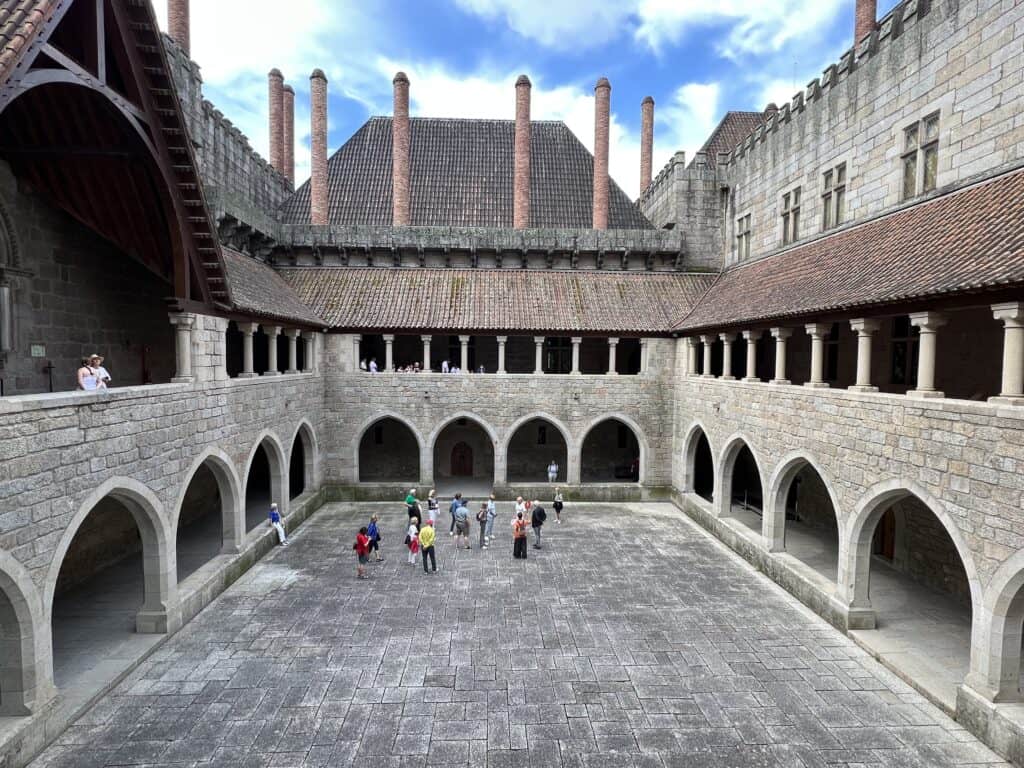
Palace of the Dukes of Braganza Built in the 1400s and restored in the 1900s, the palace served as an official presidential residence through much of the modern era. The interior contains tapestries, Chinese porcelain, and an artillery collection that reflects the sweep of Portuguese history from the medieval period through the Age of Discovery.
Oliveira Square and the Church of Nossa Senhora da Oliveira This is the heart of the old town and the place to slow down. The church was founded in the 900s on the site of the legendary olive tree. The Gothic canopy erected in the square in 1340 commemorates the Portuguese victory at the Battle of Rio Salado. The square itself is surrounded by medieval buildings housing cafes and shops. Give it time. This is not a square you photograph and leave.
The Medieval Streets The lanes connecting the castle to Oliveira Square are among the most intact medieval streetscapes in Portugal. Walk slowly. Look at the building materials, the wall heights, the scale of the doorways. This is what a city looked like in the 1200s.
Planning Your Visit to Guimarães
Getting there:
- By train: Approximately 1 hour from Porto Campanhã or São Bento
- By car: About 50 minutes / 34 miles (55 km) via A3
How long do you need: Full day. Stay overnight if your schedule allows. Guimarães after the day-trippers leave is a completely different experience.
Book in advance: The castle and palace are ticketed. No advance booking required, but arrive early in summer.
My tip: Read the story of the olive tree before you go. Stand in Oliveira Square and look at the canopy built in 1340 and the church behind it and the medieval buildings around you, and know what you are standing in the middle of. I did not do this. You should.
For the complete guide to Guimarães: click here for my full Guimarães planning guide.
4. Sanctuary of Bom Jesus do Monte, Braga
Inscribed: 2019
Type: Cultural landscape
Why it was inscribed: For its exceptional integration of Baroque architecture, sacred landscape, and pilgrimage tradition, and for its unique architectural program in which the staircase itself is a physical representation of Christian theology
What Is Bom Jesus do Monte?
Bom Jesus do Monte is a Baroque pilgrimage sanctuary built on a forested hillside outside Braga, with a monumental staircase climbing 383 feet (116 meters) from base to church. It is the most recently inscribed of the 4 UNESCO sites in this guide, designated in 2019 for reasons that go well beyond its visual drama.
The staircase is not decorative. It is a theological program built in stone.
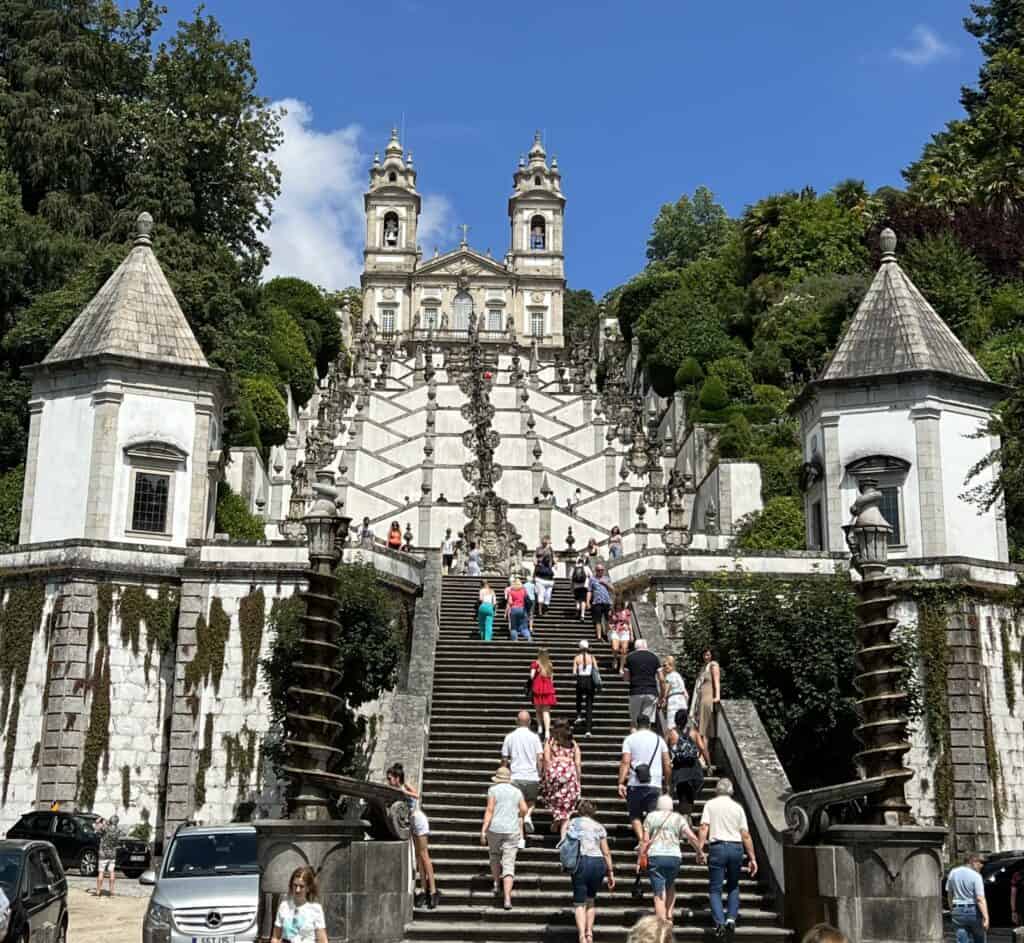
Each landing represents a stage of the Passion, the final hours of Christ’s life from his arrest through his crucifixion. The fountains at each level represent the 5 senses and then the 3 virtues (Faith, Hope, and Charity), guiding the pilgrim upward through a symbolic journey from earthly experience toward divine grace. The small chapels and altars at each landing contain scenes from the Passion in sculpted relief. Pilgrims who make this journey on their knees (and people still do) pause at each altar to reflect and pray.
I stood on this staircase in 2023 and did not understand any of this. I saw an impressive Baroque staircase. I did not see the theology. That is the gap I am trying to close for you.
Nerd Alert! ✨ The funicular at Bom Jesus, which has carried visitors up the hillside since 1882, is one of the oldest water-powered funiculars in the world still in operation. It runs on a counterbalance system: the descending car carries a tank that is filled with water at the top, making it heavier than the ascending car, which pulls the lighter car upward. No engine. No electricity. Pure physics. It has been running on this system for over 140 years.
What to See at Bom Jesus
The Staircase: Walking Down Take the funicular up and walk down. Walking down is the way to actually read the staircase. As you descend, you move through each stage of the Passion in sequence, and the architecture starts to reveal itself: the fountains at each landing, the sculpted scenes in the chapels, the altars where offerings are still made. I cover this in more detail in my full Braga guide. The key point is this: walking down gives you the experience that the staircase was designed for.
The Church at the Top The Church of Bom Jesus at the summit of the staircase is a Neoclassical structure built in the 1700s. The views from the terrace in front of the church take in Braga below, the surrounding hills, and on clear days, a broad sweep of the Minho landscape.
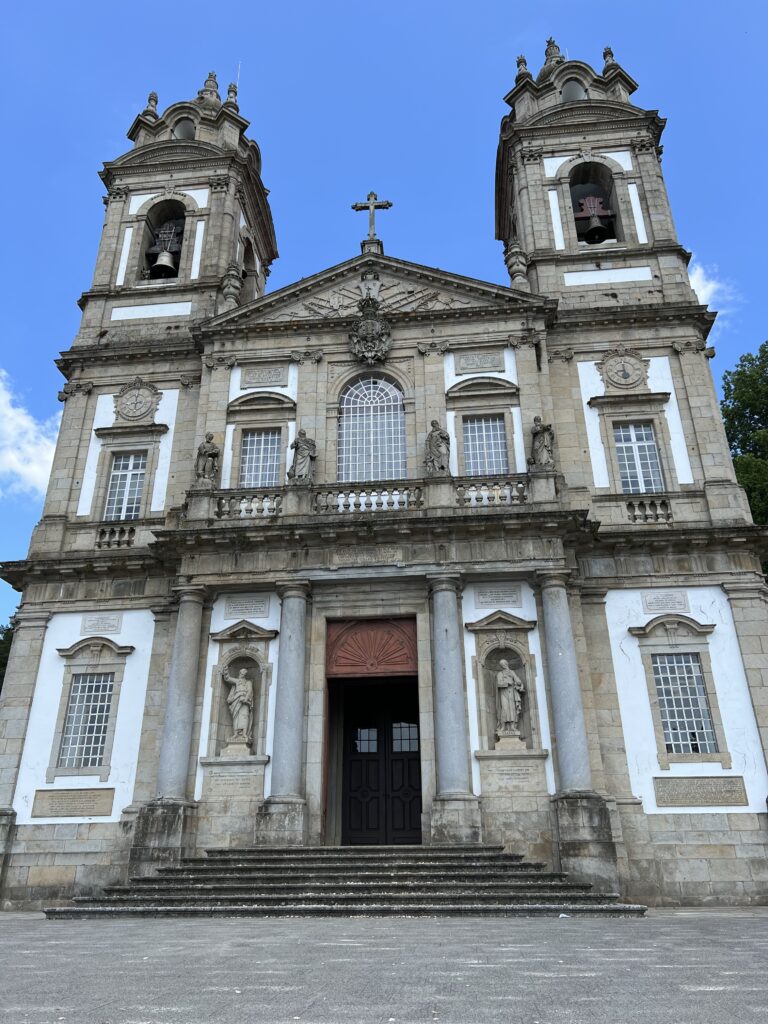
The Forest and Gardens The wooded hillside around the sanctuary is part of the UNESCO designation. The gardens contain ponds, fountains, and small chapels that form an outdoor devotional landscape extending beyond the staircase itself.
Braga’s Old Town The city of Braga is worth at least a few hours on its own. The Sé de Braga, the city’s cathedral, has been under continuous construction since the 1000s, which means you are looking at Romanesque, Gothic, Manueline, and Baroque elements in a single building.
One observation from our visit that I have not been able to stop thinking about: the Catholic Church has a long tradition of placing its most important buildings on hilltops. Not just for the views. Deliberately: to elevate the church above everything around it, to make God feel literally present from above. Once you see it at Bom Jesus, you see it everywhere. The cathedral in Lyon. The basilica in Marseille. The logic is the same across all of them.
Planning Your Visit to Bom Jesus
Getting there:
- By train: Approximately 1 hour from Porto Campanhã or São Bento to Braga, then a short taxi or bus to Bom Jesus
- By car: About 55 minutes / 34 miles (55 km) via A3
How long do you need: Half day for Bom Jesus; full day if you combine with Braga’s old town. Braga and Guimarães pair well together for a long day with a rental car or taxi between them. They are only 15 miles (25 km) apart.
Best time to visit: Mid-morning. The light on the staircase is best before noon, and you will want time to walk down slowly.
My tip: Read about the Passion before you visit. Even a basic overview of the stations of the cross will transform what you see on that staircase from impressive Baroque architecture into something that actually means something. I did not do this. Every landing will land differently when you know what it represents.
For the complete guide to Braga: click here for my full Braga planning guide.
Why These UNESCO Sites Matter Together
Each of these 4 designations tells a different story about what makes a place worth preserving.
Porto’s historic center is inscribed for continuity: a city that has been in constant use for 2,000 years without losing the shape of its past.
The Alto Douro is inscribed for a living cultural landscape: the relationship between people, a river, a rock formation, and a crop, sustained and evolved over 2,000 years.
Guimarães is inscribed for origin: the place where a nation’s identity first crystallized, and the urban model that was exported across four continents (Europe, Asia, South America, and Africa).
Bom Jesus is inscribed for sacred meaning embedded in architecture: a landscape in which theology is expressed not in words but in stone, water, and the act of climbing.
Together they cover Roman trade, medieval nation-building, global commercial empire, and hundreds of years of religious devotion. You can experience all 4 within a 5-day trip from Porto.
How to Plan a Trip to Porto Around UNESCO World Heritage Sites
If you are planning a trip specifically around Porto’s UNESCO sites, here is a 5-day framework that covers all 4 designations without rushing any of them.
| Day | Focus | UNESCO Site | Key Stops |
|---|---|---|---|
| Day 1 | Porto historic centre: upper city | Historic Centre of Porto | Twin Churches, Livraria Lello, Clérigos Tower, São Bento Station, Porto Cathedral |
| Day 2 | Porto historic centre: river and Gaia | Historic Centre of Porto | Ribeira Square, São Francisco Church, Dom Luís I Bridge, Monastery of Serra do Pilar, port wine cellars |
| Day 3 | Guimarães | Historic Centre of Guimarães | Guimarães Castle, Palace of the Dukes of Braganza, Oliveira Square, medieval streets |
| Day 4 | Braga and Bom Jesus | Sanctuary of Bom Jesus do Monte | Bom Jesus staircase, Sé de Braga, Jardim de Santa Bárbara |
| Day 5 | Douro Valley | Alto Douro Wine Region | Scenic train from São Bento, Pinhão, quinta tasting, river cruise |
A few flexible options:
Guimarães and Braga can be combined into a single long day if you have a rental car or are willing to take a taxi between them. They are only 15 miles (25 km) apart. The Douro Valley works as either a Day 3 or Day 5 depending on your energy. If you have a 6th or 7th day, the Côa Valley prehistoric rock art sites are the logical next stop for serious UNESCO collectors.
For a complete day-by-day Porto city plan, click here for my full Porto itinerary. For logistics on all day trips including train times and booking tips, click here for my day trips from Porto guide.
The Full UNESCO Picture: Northern Portugal Beyond the 4 Main Sites
This guide focuses on the 4 UNESCO World Heritage Sites most accessible from Porto. But northern Portugal’s UNESCO recognition goes further, and if you are a serious UNESCO collector, here is the complete picture.
Additional UNESCO World Heritage Sites in the Region
Prehistoric Rock Art Sites of the Côa Valley and Siega Verde One of the largest open-air Paleolithic art complexes in the world, with engravings dating back 25,000 years. Located in northeastern Portugal near the Spanish border: a dedicated detour from Porto, but profound for travelers interested in deep human history. Inscribed 1998/2010.
Manufacturing of Black Pottery from Bisalhães This is a different category of UNESCO recognition: Intangible Cultural Heritage, not a World Heritage Site. The black pottery tradition from the village of Bisalhães near Vila Real has been practiced continuously for thousands of years using techniques unchanged since the Iron Age. It is on the UNESCO list of Intangible Cultural Heritage in Need of Urgent Safeguarding.
Carnival of Podence Also UNESCO Intangible Cultural Heritage: the Carnival tradition of Podence in the Trás-os-Montes region, featuring the Caretos (masked figures in colorful costumes who roam the streets during the pre-Lenten festival). A living tradition with roots stretching back hundreds of years.
UNESCO Global Geoparks Northern Portugal has 2 UNESCO-recognized Geoparks: the Arouca Geopark (home to the Passadiços do Paiva walkways and some of the world’s largest trilobite fossils) and the Terras de Cavaleiros Geopark near Macedo de Cavaleiros. Geoparks are a separate UNESCO designation recognizing areas of significant geological heritage.
Why the distinction matters: World Heritage Sites (the 4 covered in this guide) are inscribed under the World Heritage Convention and represent places of outstanding universal cultural or natural value. Intangible Cultural Heritage and Geoparks are recognized under different UNESCO programs with different criteria. All of them are worth knowing about, but they are not the same designation, and not all travel guides make that clear.
If you are planning a trip to experience all 4 UNESCO sites, here is the order that makes the most historical and logistical sense:
- Porto Historic Center (Days 1-2): Start here. Get oriented in the city, walk Ribeira, visit São Francisco and the cathedral, cross the Dom Luís I Bridge.
- Guimarães (Day 3): Take the morning train. Visit the castle, the palace, and Oliveira Square. Understand where Portugal began before you explore more of what it became.
- Braga and Bom Jesus (Day 4): Take the morning train. Walk down the staircase slowly. Combine with Braga’s old town in the afternoon.
- Douro Valley (Day 5): Take the scenic train from São Bento. End your trip in the landscape that built Porto’s wealth and still produces the wine you have been drinking all week.
Guided Tours of Northern Portugal’s UNESCO Sites
Some travelers prefer to experience these sites with a guide who can provide deeper historical context on the ground.
- Porto Historic Center Walking Tour
- Guimarães Historical Origins Private Tour
- Braga + Guimarães Full-Day Tour from Porto
- Full-Day Douro Valley Wine Tour with Tastings
FAQs About Porto’s UNESCO World Heritage Sites
How many UNESCO World Heritage Sites are near Porto?
There are 4 UNESCO World Heritage Sites within easy reach of Porto: the Historic Center of Porto, the Alto Douro Wine Region, the Historic Center of Guimarães, and the Sanctuary of Bom Jesus do Monte in Braga. Northern Portugal also has additional UNESCO recognition through Intangible Cultural Heritage designations and 2 UNESCO Global Geoparks.
What is Porto’s UNESCO site?
Porto’s UNESCO World Heritage Site is the Historic Center of Porto, inscribed in 1996. The designation covers the Ribeira district and the broader historic center, including the Dom Luís I Bridge and the Monastery of Serra do Pilar across the river in Vila Nova de Gaia.
Is the Douro Valley a UNESCO World Heritage Site?
Yes. The Alto Douro Wine Region was inscribed as a UNESCO World Heritage cultural landscape in 2001, recognized for its 2,000-year history of wine growing and its extraordinary terraced landscape along the Douro River, shaped entirely by human hands.
Are Guimarães and Braga UNESCO sites?
Yes. The Historic Center of Guimarães was inscribed in 2001 for its role as the birthplace of Portugal and its remarkably intact medieval urban fabric. The Sanctuary of Bom Jesus do Monte in Braga was inscribed in 2019 for its exceptional integration of Baroque architecture, sacred landscape, and pilgrimage tradition.
Can you visit all the Porto UNESCO sites in one trip?
Yes. A 4 to 5 day trip based in Porto gives you time to experience all 4 World Heritage Sites meaningfully without rushing. See the itinerary table above for a suggested day-by-day framework.
Do you need to book tickets in advance for Porto’s UNESCO sites?
For Livraria Lello in Porto, yes. Book at [livrarialello.pt]. For the Douro Valley scenic train in summer, buy your return ticket before you board at São Bento. For Guimarães and Braga, advance booking is not required but early arrival is recommended in peak season.
What is the best UNESCO site to visit near Porto?
All 4 are worth visiting for different reasons. Guimarães offers the strongest historical narrative: the literal origin point of Portugal. Bom Jesus do Monte in Braga is the most visually dramatic. The Douro Valley is the most immersive landscape experience. The Historic Center of Porto is the most layered and complex. If you can only choose one day trip from Porto, Guimarães is the one I would recommend first. Followed very closely by Braga.
Final Thoughts: Come Prepared
Northern Portugal rewards the prepared traveler more than almost anywhere I have visited.
The details are there. The history is layered into every square, every staircase landing, every church built on a hilltop for reasons that go far beyond the view. But you have to know to look for them.
I did not know in 2023. I know now. And this guide exists so that you can stand in that square in Guimarães (or on that staircase in Braga) and actually feel the weight of what you are standing in the middle of.
That is what traveling like a nerd means. Not just seeing the thing. Understanding it.
If you would like help planning a custom northern Portugal itinerary built around these UNESCO sites and your specific travel style, click here to work with me.
More Northern Portugal Planning Resources
- Best Day Trips from Porto: logistics and history for all 10 destinations
- Porto Itinerary: 3-5 Days: day-by-day guide to the city itself
- Guimarães Planning Guide: complete guide to the birthplace of Portugal
- Braga Planning Guide: complete guide to Portugal’s sacred city
- Portugal Travel Guide: the full country overview with all 17 UNESCO sites